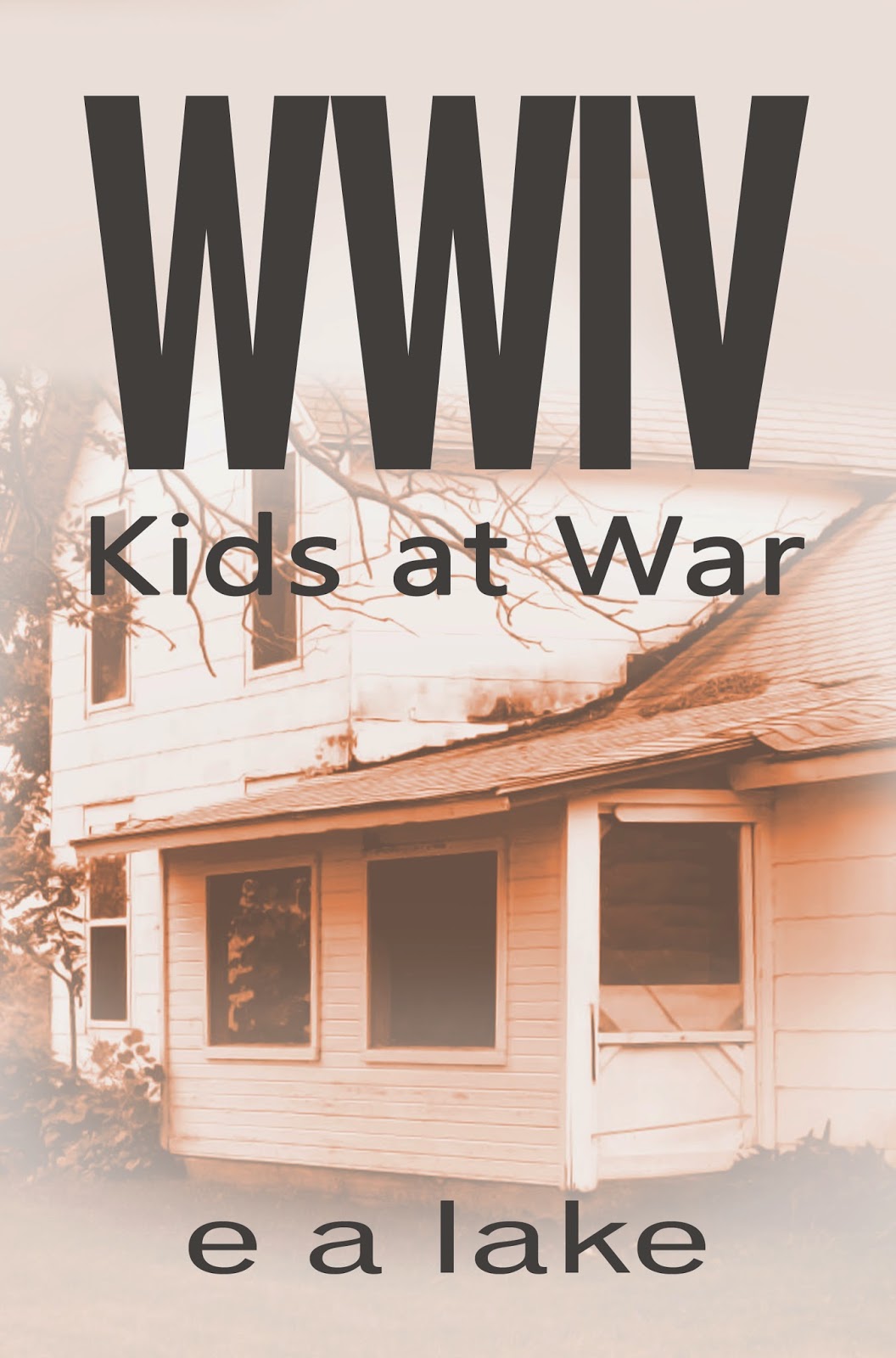
WWIV Book 1

FOUR WWIV Books are now available on Amazon.
Click here for more information.
Showing posts with label self-published. Show all posts

Saturday, August 26, 2017

Cover Reveal - Coming in October 2017

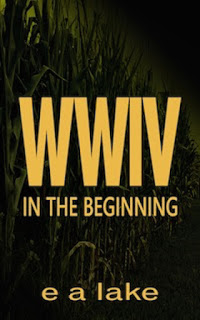
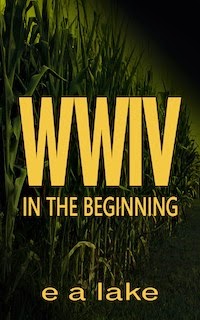
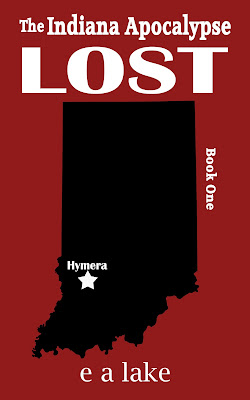
It's been a while since my last release. So I'm happy to have a new post-apocalyptic series coming this fall. Here is the cover of book one:


I believe I've put on interesting spin on the apocalypse for you. To read more about this upcoming novel click here for a brief synopsis.

I promise to keep you updated as I get closer to publication.


Have a great week now,

e a lake


Sunday, January 29, 2017

"Glitched" - Chapters 1 & 2

Chapter 1


A small part of me died as I watched them lead Lucy Tringle out of the front door of her apartment building. I can’t say it was the roughest handling of a suspect I’d ever seen. Actually, the whole scene was quiet and the young 20-something woman moved as requested without incident.

I noticed her hands were cuffed behind her back. A black-jacket on each side held an arm, directing her towards the idling white government van. If she were afraid her face didn’t show it. No, she seemed as dull and boring as she did most days when I watched her leave for work at the Information Repository.

When they turned right on the sidewalk I realized Lucy wasn’t wearing any shoes. All she had on was a pair of khakis and an orange sweater. The neck of her sweater, I believe they called it a cowl-neck, rode almost to her chin. I loved that sweater; I loved that sweater especially whenever Lucy wore it. It showed off her womanly assets that made the otherwise bland library-type woman a real woman, one with adult curves and shape.

Watching from my front porch, they loaded her carefully in the back of the decade old vehicle and closed the door cautiously. I thought the whole scene was odd. Usually, when they drug a peeb out from wherever they found them hiding, the suspect was almost always kicking and screaming. Many times I’d witnessed the black-jackets thrust a suspected peeb into the back of a van, almost hoping a foot or head was in the way when they slammed the rear doors closed.

So, Lucy was a peeb, go figure. Except I knew she wasn’t. They had to have made a mistake, the Truth and Honesty Commission that is. Her arrest, they’d call it an informal interrogation, was the result of some glitch naming her as a malfeasant, which of course wasn’t true. Someone had just simply run short on names and tossed hers out in exchange for food.

Closing my book, I watched them pull away as if they were out for an early morning drive. I rose and stretched, losing sight of the vehicle as it turned left at the next street and disappeared behind an apartment building.

“Ma,” I shouted. “I gotta go out. Be back in a bit.” Yeah, I was almost 30, still unattached, and lived at home with my single mom. That pretty much summed up my entire existence.

“You want me to make you a sandwich, Trent?” she replied in a shrill voice, her normal. “It’s almost lunch time. You might get hungry.”

While a sandwich sounded good, I had other things at the forefront of my mind.

“I’ll grab something a Gareth’s, Ma. I gotta run. They just pinched Lucy.”

I heard her footsteps coming closer, though I didn’t bother to look back.

“Did you squeal?” she asked. I didn’t like her tone; she was trying to make me feel guilty.

“Lucy’s my friend, Ma,” I replied, pulling on my jacket as I reached for the screen door. “I’d never do that to a friend.”

I heard a huff come from the great criticizer. “Friends talk to each other; friends say hello and how are you. Friends don’t sit on the front porch like a stalker, watching her every move like she was a doll on display.”

Her long pause was a weak attempt to extract a response from me. But we were experts at that dance. She and I both knew I wouldn’t reply to such a load of crap.

“Friends,” she continued, almost sounding teary. “Real friends warn one another when they might be being watched. Did you warn Lucy, Trent?”

I pushed out the door and hopped the three steps down in a single bound. The gray day was cooler than I had anticipated. Perhaps a thicker jacket was in order. But that would mean going back and facing Ma again. She’d expect an answer.

Kicking the rusty gate open, I headed left down the weeded-over sidewalk. I needed to produce today. I needed to give those bastards, my keepers, something fresh. We – me and Ma – needed another month’s worth of food.

Even if it meant being a glitch.


Chapter 2


Arriving at my friend’s place I noticed the front door slightly ajar. As I eased inside I took in the front room. Papers were strewn everywhere. Plates of half-eaten food sat atop piles of garbage. The floor was as filthy as the pig shed at the government farms.

In other words, everything seemed normal.

“Gar,” I called out, closing the door behind me. “What you doing, buddy?”

A clatter sounded in the kitchen. Either someone was stealing the last of his spoiled food supply, or Gareth was having lunch.

He appeared in the doorway between the rooms. Standing in his open bathrobe, showing off his dirty underwear, he held a bowl of steaming noodles in front of his unshaven face. He looked like hell – again, normal.

“What up, little dude?” Slurping in the last of his lunch, he sat the bowl down on a counter that I knew was as cluttered as the rest of his place. Ah, the joys of outliving your parents.

“They pinched Lucy just now,” I replied, taking a spot on his faded saggy sofa. It was perhaps the only spot to sit in his dump.

“You squealed on your girlfriend?” he exclaimed in a high-pitched voice. “Dude, you’re never going to see her again.”

Folding my fingers together, I rested my hands in front of my lips and let out a long sigh. Gareth was a moron, and perhaps my only true friend.

“I didn’t do anything, you know that.”

He lumbered past me and sat his 6-6 frame in a chair after he whipped dirty laundry from it first. At least I assumed it was dirty. I gawked at him for a brief second, noticing his junk hanging out of the front of his robe.

“Close it up, man. That may work for the skunks you hang out with but I don’t want to see it.”

He laughed and pulled his robe closed. “Need some intel?” I could always count on him to read my mind.

“I just want to know where they took her,” I replied quietly. “That’s all.”

He pulled a keyboard from beneath another pile and the TV came to life. Entering a string of what appeared to me as gibberish, his hands flew around the keys. When I saw the government’s emblem appear on the screen I raised a hand for him to stop.

“You’re sure this is safe?” It wasn’t meant to offend him; the question was meant more to protect myself.

His grin spoke volumes. “Dude, you ask me that every time. Of course it’s safe. Those hacks downtown don’t know squat about data security. They don’t even know I’m in here. Chillax, man. We’ve done this a hundred times. I’m not about to get caught now.”

Just as he finished the screen went black. My stomach fell and I was glad I hadn’t taken Ma up on her sandwich offer. It would have been shooting all over Gareth’s living room…not that anyone would have noticed.

He tossed his keyboard aside and stormed towards the 50-inch screen. Playing with something on the back, the set came back to life.

“I gotta get some new equipment,” he said casually. “I swear that thing shorts out every time I used it.”

“While you’re in there,” I said, watching him pound the keys again, “see if you can grab me a name of someone they’re watching. I need a mark today.”

His smirk made me feel almost human. Gareth got it. There were two ways a glitch could get by. One was to do a bunch of legwork, following people all day, waiting for them to do something suspicious. The other, my preferred method, was to give the government boys and girls what they wanted – someone they already suspected had peeb ties.

“They took her to Station A,” Gareth reported, making his way stealth-like through screen after screen of detail. “She’s just in holding for now. They haven’t even assigned an interrogator yet.”

“Who glitched her?” I asked. I wanted the name of the weasel that snitched on her.

A glitch was nothing more than slang for glorified snitch. I had no idea how the name peeb ever came about. It was just what the government gang had always called people suspected of working against their ideals.

“Margo Hanks,” Gareth replied, pounding out new commands for the computer. “Here’s her picture.”

Before us, in full living color, was a person as dull as Lucy. Perhaps even a little more. At least my friend was somewhat cute and curvy. This gal, Margo, had the appearance of a young teen whose best friends were her cat and a large stack of books.

My eyes floated down the screen as I read her credentials. Twenty-eight, single, no known male attachments, purchased alcohol only on government holidays, wore a size four shoe. Nothing was extraordinary about this one.

Except her employer.

My eyes met Gareth’s. He saw the same thing.

“They work together,” he said. “The bitch turned on a co-worker.”

Her report to the OOD (Office of Decency) – a department of the Truth and Honesty Commission – was straightforward. Two weeks prior Margo had witnessed Lucy answering a question from someone she considered unworthy of information. That was it.

To be honest, that’s all it took to get hauled away by the government. To say they ruled with an iron fist made it sound as if they were a loving grandparent. Once a peeb, suspected or real, was in their dungeon the chances of ever leaving were next to none.

That, I’m afraid, was Lucy’s fate.

“I think I have your mark for you,” Gareth said, rising and leaving the room. “Go see Captain Kumquat and glitch on Margo. I’ll dig something up they already have on her. Not that they ever check their files for former information once they have a name.”


I inched closer to the screen, studying the face of my target. She didn’t know it at the time, but Margo Hanks was about to become public enemy number one.


----------------------------------------------------------------------------------------

All material is the intellectual property of e a lake. Please don't steal it, but feel free to share this with anyone you might think will enjoy it. Also -- and this is a biggie -- if you have any input on the grammar, or content, or ideas for upcoming chapters, please make a comment. Let's create this novel together. And with your help, it can only become better.

Thank you,

e a lake

Did you know this ebook is always free!? And in various formats? Click it to find out more.


Wednesday, October 21, 2015

Amazon Cracks Down on Fake Reviews

Okay, everyone with a blog is probably writing about Amazon's lawsuit this week. So, why not jump on the bandwagon while it's screaming downhill with no brakes I figure.


Anatomy of a fake review

Let me make one up for a friend's new book (which I may or may not have read):

Outstanding piece of literature from this author. Pace, dialog, and plot are perfect. Kept me engaged from the first sentence on. I'd give it six stars if it was at all possible. Can't possibly recommend this book enough to all readers. 

Perhaps a little over the top, but you get the idea.


Not all fake reviews cost money

I watched a fellow on an early morning news show talking about "fake" reviews. It seemed, according to his report, that most of these paid for positive comments happen on products, not necessarily ebooks or books in general.

Well, duh! Who needs to pay for fake reviews when you can simply have your friends and family hawk your writing. My faux review above is for my friend, and I could easily give it to her.

There are several tells in the game

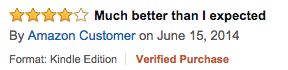
1. The words "Verified Purchase" are missing from the review.


Here's one from my first book: WWIV - In The Beginning. 

Now that's not to say the review isn't legit - if those words are missing. But if they received a free copy of the manuscript in exchange for an honest review, well - that needs to be pointed out.


2. There are too many reviews in relation to their ranking on Amazon.

Again, referring to my first book, I have 52 reviews and I've sold almost 5,000 Kindle copies. That's a 1% review-to-sales ratio. That book ranks between 100,000 and 300,000 typically on the Sales List after a year and a half.

So, how can someone publish a book, a month later have 15 mostly 5-star reviews, and be ranked at 1.5 million. That tells me they have only sold A copy of their book (one).

But what about those grandiose reviews? Well, thank you friends and family.

So, what do we do about fake reviews?

Me, nothing. Couldn't care less. That's their problem, not mine. Doesn't effect my sales or ranking one bit. And I'm writing because I love to do it, not for the minor accolades.

My daughter wrote a review on GoodReads for Book One. She gave me three stars. Nice try in other words. My brother gave me four stars on Amazon. And that was after he went out and bought it for his Kindle.

Either Amazon will clean up these fakes

Or, people will learn to ignore them

And I'm okay with either choice. Already you will notice people questioning the inordinate amount of five star reviews on some books...even ones published by the Big Boys.


What are your thoughts on the subject? I would love to hear what you have to say about (obvious) fake reviews, and how you feel they effect our industry.


Until next week - when I really think I will have that #GoT post done - have a good one!


e a lake

(click on my books below to see more)


Wednesday, September 30, 2015

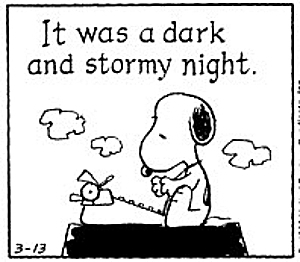
It was a dark and stormy night...

Most of us believe that it was Charlie Brown's dog, Snoopy, that first penned these words. Not true, my friends, not true.


Actually, that is the opening line written by English novelist Edward Bulwer-Lytton in his 1830 novel Paul Clifford. 

I have to be honest, I've never read Paul Clifford. And until a few weeks ago, I would have given credit to Charles M. Schultz (the creator of Peanuts) for penning the words. And, of course, I would have been wrong!


So, what's my point?


A great opening line can really set the tone for the reader. Consider these:

"It was the best of times, it was the worst of times." (Dickens: A Tale of Two Cities)

"Lolita, light of my life, fire of my loins. My sin, my soul." (Nabokov: Lolita)

"It was a pleasure to burn." (Bradbury: Fahrenheit 451)

And, of course:

"Call me Ishmael." (Melville: Moby Dick)

Not all Opening are created equal


Sometimes a story just starts; no banging of drums or blaring of trumpets. The writer eases into their words - hopefully sucking the reader along. If he or she is good, you keep going. But at times even great writers lose their reader in the first chapter, the first paragraph, perhaps even the first line.

Think about this the next time you start a new novel. See how the writer draws you into their world; a world created just for the readers enjoyment. What is it that makes you keep going? The story? The characters? Or perhaps something about the setting?

As a writer I often ease into the story, letting the reader become comfortable with the pace and setting. I have used flashy first lines, but that's the exception not the rule for me. 

Let me draw you in, dear reader. Let me create a world, for you, that is so easy to believe, so real, that you can't put my book down.

I hope that's what I do, at least. I've received many wonderful reviews and comments on my three published novels (see below). 

Tell me about your favorite opening line (or chapter) in the comment section below! I'd love to hear what each of you has to say.


Until next week, check out one of those novels I've mentioned above. Perhaps even give Paul Clifford a chance; I know I might.


e a lake

(click on my books below to see more)


Wednesday, July 8, 2015

Big News - X2

Last night, at approximately 8:00 p.m. (central time zone) I finished my tenth complete manuscript.

Now, if you have ever written a novel - a manuscript is just an unpublished novel - you know how good it feels to wrap one up. No, good is a terrible word here. Let's try - great! Nah, that's still short of the true feeling. How about this:

I have been released from the shackles of creation, allowed to step beyond the page and breathe - as if for the first time bringing air into my tired lungs.

Yeah, over the top. But when you're in my spot, it's really how you feel.

This one was tough

To finish, that is. I don't know what went wrong. A month ago I was within 20,000 words of the end. Wrapping things up, your daily word output can easily be 2,000 a day. But I languished over finishing it. The ending was firm in my mind; I had memorized every scene, every word of dialog.

Yet, I drug my feet.

Then this past weekend I put the petal firmly on the floorboard and finished the beast. The last two full days of writing produced 7,000 and 6,000 words respectively.

And now it's done.

And I'm Happy, Yet Sad

Happy because I have a decent rough draft of a pretty darn good story. The ending has a few twists that worked out perfectly when placed on paper. The final scene is short, yet poignant.

Sad because I'm done creating this particular stand alone novel. And now it's time to let the tale stew and fester, alone on my hard drive for a month or so. And then starts the editing and rewriting process.

Most writers despise the second part of the writing process: create, edit, publish - edit is in the middle of that list. But here your creation, my creation, becomes more than just a rough draft. Here, in this long process, it truly becomes a novel. And by the end of this stage - six months perhaps, maybe longer - you will have a publishable piece of literature.

What's it about, lake?

This novel is a stand alone. There will be no sequels or prequels. It is a dystopian creation, somewhere along the lines of Orwell's 1984. Along those lines. Be sure to note that phrase carefully. I did not rewrite a modern version of Orwell's classic. I wrote my own tale.


This manuscript came in at a little over 100,000 words. Most likely the final version will be somewhere in the low 90s. Remember what Stephen King tells us: 

2nd Draft = 1st Draft minus 10%

Big News - Part II

This past week, visits to my blog passed the 10,000 mark!

I have been blogging since February 13th, 2014. Seventeen months or so. For the first little bit (six months) I posted something twice a week. Fort the last year or so it's been once a week. But still, I couldn't be more thrilled.

Thank You to each and every person who has read my blog. 


Until next week, join me in reading the Games of Thrones (Book One - that's the actual title). It's only 850 some pages long, shouldn't take but a few late nights, right?


e a lake


Wednesday, April 8, 2015

Show, Don't Tell (A famous quote most authors understand)

I was mad, really mad. I hurriedly walked into the room. I needed to find my wife and take my frustration out on her.

Okay, before you get too upset, the above sentence is an example of something that any author may write. It is not what was going on right before I began writing today. All-in-all, the above mess gets the point across to the reader. Someone was mad, they hurried into the room, and looked for his wife. We can do better though.

I ran into the living room, my fists clenched, ears ringing. Scouring the area, I noticed my wife missing. "Where the hell are you, Carolyn?" I screamed. "You owe my a huge explanation."

So what's the difference you ask? Simply put, I told you everything in the first sentences; in the second, I showed you what was happening.

One of the most difficult concepts for new authors to get a handle on is the Show vs. Tell idea. Didn't I mention he walked "hurriedly" in the first one? I told you he was "mad". The reader should get the idea, right?

The answer is: maybe

I'm going to try and keep this short and sweet, without going into boring detail. But to me, it's all about the verbs.

Let's start with walked vs. ran. The first problem with the verb walked is that I used an adverb (a -ly word) to modify the first word. "Walked hurriedly" gets the point across, but what we really need to do is search for a better, stronger verb to make our sentence really shine.

That's why I used ran. You can see that action clearly in your mind. The same goes with mad (more of an adjective, yet can be a verb). Don't just tell your readers someone is mad - show them mad/angry.


Another example

The woods was beautiful today. Karen looked at the new green leaves, moving wildly in the strong breeze. She smiled, remembering the woods of her youth.

That's okay, but I basically told you about the scene. I showed you very little.

The breeze caused the spring foliage to flutter as if they were being shook by a giant. A musty odor reached Karen's nose, the smell of decay. She remembered as a child playing in piles of brown and orange as her father raked the backyard. The corners of her mouth curled upward; how long has it been since I thought of Dad? she wondered.

First off, I used a metaphor with the giant. These are great tools, just don't overuse them. Next, I killed the verb, adverb in the first (moving wildly) and replaced them with a stronger verb (flutter) - followed by the metaphor.

I also tell you Karen smiled and remembered her childhood without using those exact words. I gave you the specific memory (dad and/or) raking of leaves. And what is a smile if not the "corners of her mouth curl(ing) upward?"

Writers, good writers, learn how to show their readers almost everything. Rarely will they use words like mad, or happy, or beautiful. No, they show you what mad looks like, what happy might sound like, just how beautiful as rose really is.

 I'm not there yet, though I'm trying. It's hard to get the hang of this when you first start writing. But, as with anything, practice makes you better. Thus, I'll keep practicing.

(And remember to sign up for the free drawing to both of my novels in paperback form. Click here for details.)


Until next week,


e a lake


My Books:


Wednesday, April 1, 2015

April Promo - Paperback Giveaway (Signed)

HI ALL!

I'd like you to enter a giveaway. No big catches, nothing to buy, you don't have to promise to be my friend. All you need to enter is an email address - and I assume if you are on-line reading this, you have one.


What am I giving away? Great Question.

At this time I have two books in print: WWIV - In The Beginning, and, WWIV - Kids at War. By summer I will have two additional books ready for reading. I will be giving away two copies of each (in The Beginning, and Kids at War). One set on April 15th (Tax Day in the US), and another set on May 1st (May Day - all around the world, I believe). All will be signed and personalized for each of the winners.

Here's how you enter:

That's it, sign up and you are entered. I will announce, on my blog - this blog, the winners on April 15 and May 1. I will contact the winners at those times for their shipping information.

And there are no losers in this deal. Just providing me with your email address will keep you informed for future giveaways. I'm already planning a huge 4th of July promo; you will want to be part of my list for that (details in June).

As always, thank you for following this blog. Also, for those who have purchased and read my novels - Thank You, as well. I would be lost in this journey if not for you.


Have a great week, and enter for free paperbacks. Please feel free to enter once a week (if you would like to increase your odds of winning).


e a lake


My Books:


Thursday, March 12, 2015

The Dreaded Semicolon; or in my case, The Semicolon, man's greatest invention

Truth be known, I actually know how to properly use a semicolon. But...that doesn't mean I use it correctly as I create.

The semicolon is a punctuation mark used to connect to thoughts of a similar nature. At least that's how I define it. But according to another source, Wikipedia, it is defined as such:

A semicolon can be used between two closely related independent clauses, provided they are not already joined by a coordinating conjunction.

Yeah, okay, I get it. Let's agree that thoughts equal independent clauses. And I guess I left out that conjunction thingy. But, all in all, my definition pretty much matches the given definition pretty darn close. Don't you agree?


Here's the thing: When I am creating a rough draft of any manuscript, my mind is going six thousand miles a minute. Typically, I'm a sentence or two ahead of any given point I might be writing. I'm thinking of the next paragraph of narration, or perhaps some snappy dialogue. When it comes times for proper punctuation, I'm like a prize fighter moving in for the kill. Be gone training and technique; away with any sage-like advice. Let's get this over with!

So, I end up with sentences like this:

As he was about to turn back to her, a speck appeared in the sky; far away and falling swiftly to earth. (This line is from my soon to be released novella: WWIV - Darkness Descends.)


Once an editor gets their hands on my material, they love to add a comment just like this: "You are using the punctuation mark, the semicolon as a comma. When you use a semicolon, there needs to be a complete sentence after the mark" (actual wording from the editor of the rough draft).

Yeah, I know. These two thoughts in the sentence are not independent. I've been told this same advice many times over already. In book one and two of the WWIV series, my main editor, Rob Bignell, might have noted this one hundred times. By the tenth time, I think he just took to changing the semicolon into a comma. He's a smart guy.

Here's one that I caught using Grammarly, an Online Grammar checker:

Kate was absent; and that left just the Little Queen and Mara to listen to Raison. 

I most likely would have caught this error in the proofreading stage. This one would have never been seen by an editor. At least that's what I'm telling myself right now. 

With a conjunction in the sentence (and), a semicolon should never see the light of day. But there it was; no sense in denying it. And doesn't even sound correct if I change the semicolon to a comma. In this case, I simply removed the word "and" to make wise use of the punctuation.


Kate was absent; that left just the Little Queen and Mara to listen to Raison. 

Now that I study that sentence closer, there has to be a better way of saying what it is I mean to get across. I think I'll just scratch that one from my rough draft entirely.

Even though I am fast approaching the one million-word mark in my writing career, anyone can plainly see that I have a ways to go before becoming proficient at this trade. With that in mind, I will set out this year to become better at:


1. Using funky punctuation such as the semicolon and the em-dash (--).
2. Learn the proper use of gerunds (was running, were coming). Something to do with cleaning up my tendency to slip into the passive voice, from time to time.
3. Listen to my editors carefully, and depend on these professionals to clean up where I may still fall short.


I am not perfect at anything, much less writing. But this year I will strive to become the best I can; so help me George Orwell. (You can check me on this, but I think I used the semicolon properly in the preceding sentence - there may be hope for me yet)!


Until next week, stay warm everyone!


e a lake


My Books: